
Ground Realities: What a Craft Symposium Taught Me


Some times by a rare chance I happen to attend a seminar or workshop which leaves a deep impact on me and nothing impacts more than truth and attending this symposium by OCO on 20th Sept 2026 was one such occasion.
The day was fruitful. Here's why I feel the need to record my understanding and the take away from the event.
For me as an artist, obstacle and difference has always meant gender and race. Being a woman artist, also called a brown artist, my world and artistic struggle starts from there and goes beyond.
But when I went on Sunday to this symposium, I realised the ground realities that artists and artisans face in India at grassroot levels are different and layered.
The discussion focused on the artist as ethnographer. A residency followed by a fellowship takes into account interacting with a particular craft community to build an in-depth understanding of it.
The artists learn how the body adapts to the craft. This takes years to embed into the body's memory. The research covers untold stories, the thought process embedded in creating a craft, and social realities and challenges faced by the craft community, all well documented through photography. They are creating a beautiful, strong living archive.
I understand muscle memory is required to drive a vehicle or play golf. Similarly, to create a craft, the body must develop its own memory, which may demand years of dedicated effort just to learn the practice. How long the body and mind must train to develop the involuntary muscle movement specific to the craft.
Without institutional support, artisans stay poor and struggling, and the craft slowly gets wiped out of the system. After years of practice, which is the very demand of the craft, if it is not financially viable, why would anyone enter or sustain it?
OCO focuses on only one craft a year. After six weeks of residency and eight months of fellowship, the documentation is published as a book exclusively dedicated to that craft to bring it visibility. This year they focused on applique work.

Now let me share why craft must be preserved with special effort and the challenges faced by artisans.
Within artisan communities, the barriers are around religion, caste, and financial status in the social hierarchy. These are ground realities inherited through generations and not easy to ignore or address.
When the artist as ethnographer enters, he/she has to understand the social context, how the skill is acquired and nurtured at body level, other social aspects associated with it, and the craft-specific challenges. A photographer documents everything as a photojournalist, the visible challenges and untold narratives of the practice.
I also liked the approach to institutionalise art and crafts. Some of the invited panelists have been working with a particular community for more than two decades. They have come to know communities that are very secluded, lead private lives, do not like coming into the public, and do not welcome outside interference. Some communities are highly hostile towards outsiders.
Establishing credibility and trust takes a lot of time. When you are part of a community as a facilitator, you have to be very intelligent about where to draw the line. What part of life gets recorded for the external world and what never comes up for publication is the intellectual discrimination of the person working at the grassroots.
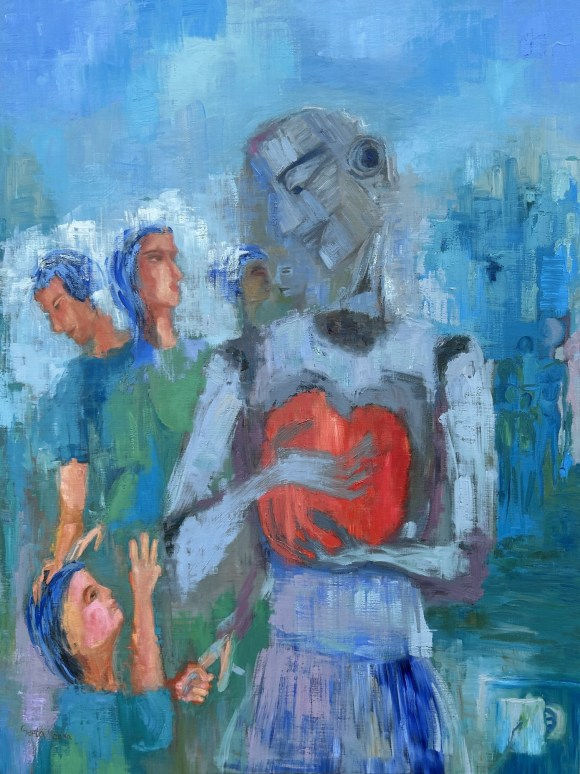
I wonder how AI will deal with it! Let's take a moment to feel proud about this human quality to discriminate good from bad.
Things that would generally be considered peculiar cannot and should not be recorded, out of respect for the community and their need for privacy.
There was also a discussion about how when artists and artisans come together, the interactions reveal a feeling that the artist is slightly superior to the artisan. Where this thought comes from is not the issue, but it is a fact. There is a dichotomy between art and artisans and it is binary.
How to bridge the gap is a big challenge OCO is working on. Another panelist had the opinion that art and craft is non-binary. But when you are operating at community level, you will see the distinctions, the differences, the anomalies, which are difficult to ignore at operational level. I wonder, do we go with opinion or fact-based reality? To institutionalise a non-binary art and craft system, the starting point would be accepting fact-based reality.
At the end of the discussion, I asked Mr. Premjish Achari, the Founder Advisor of OCO, what next. With the advent of AI, I wanted to know how it can be useful in their present scenario. He said they are developing their own LLM and it will take a few years to integrate, because bringing AI at this level will be a disruption. They will go slow, study where they can implement it and how they can bring in that change.
Personally I feel AI is not trained to understand the Indian cultural milieu. We are still left with a whole lot of the world where AI cannot enter because of layered cultural and social differences that are difficult for even a human being to understand, unless they are really sensitive. And then such sensitive people have to train the model, not in western understanding and perception but in local social and cultural sensitivity.
To know more about Odisha Craft Odyssey please follow this link.
Image credits: OCO.


Comments